Problem
In finance, a confident answer with no lineage is worse than no answer. A controller cannot put a number in front of the board unless she can trace it to a bank feed, invoice, or stated assumption.

A finance and accounting AI workspace for asking questions, generating reports, and tracing every figure back to its source file, integration, and assumption, designed so a controller can trust a number before it reaches the board.
Finance, Accounting AI Workspace
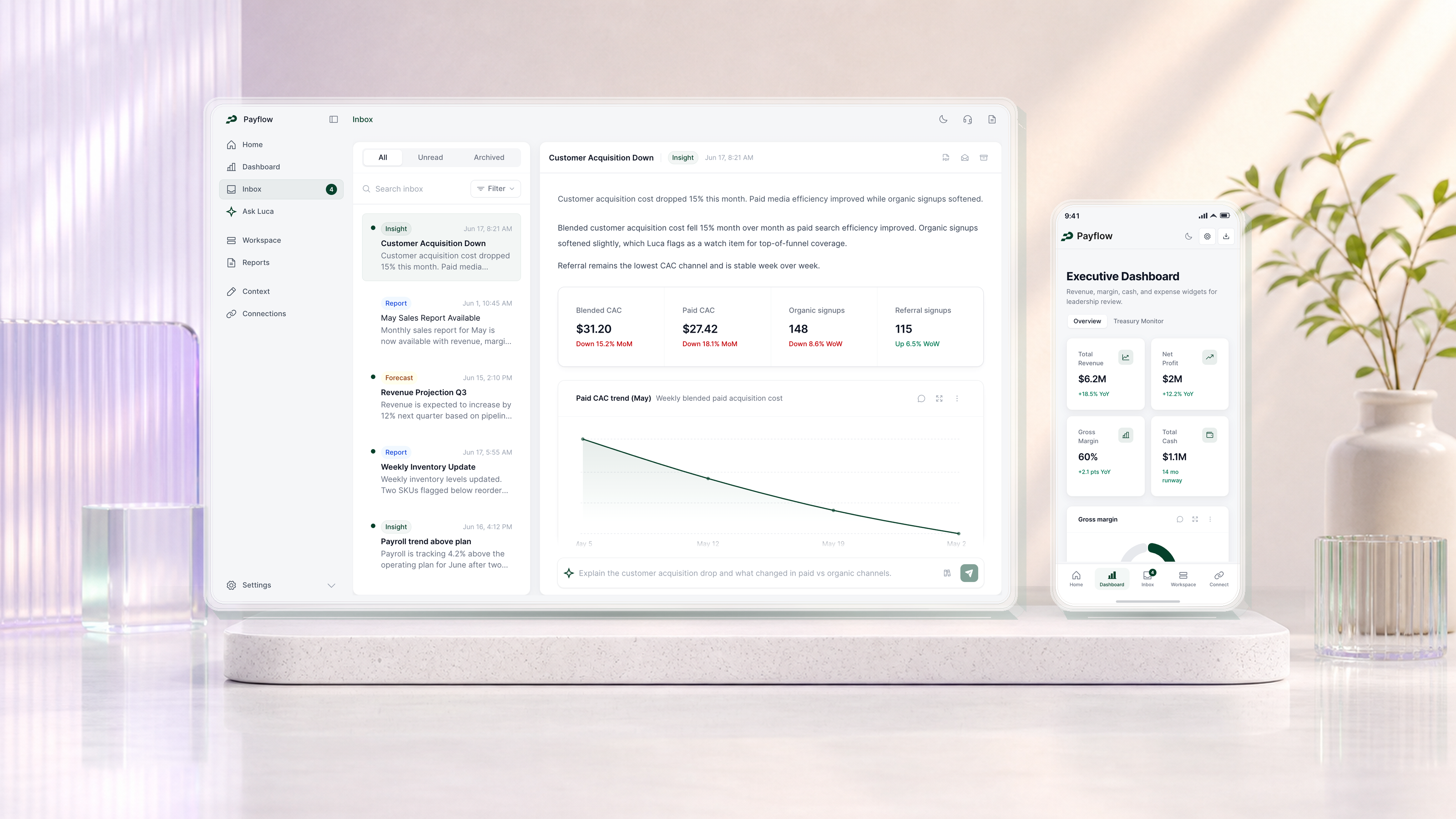
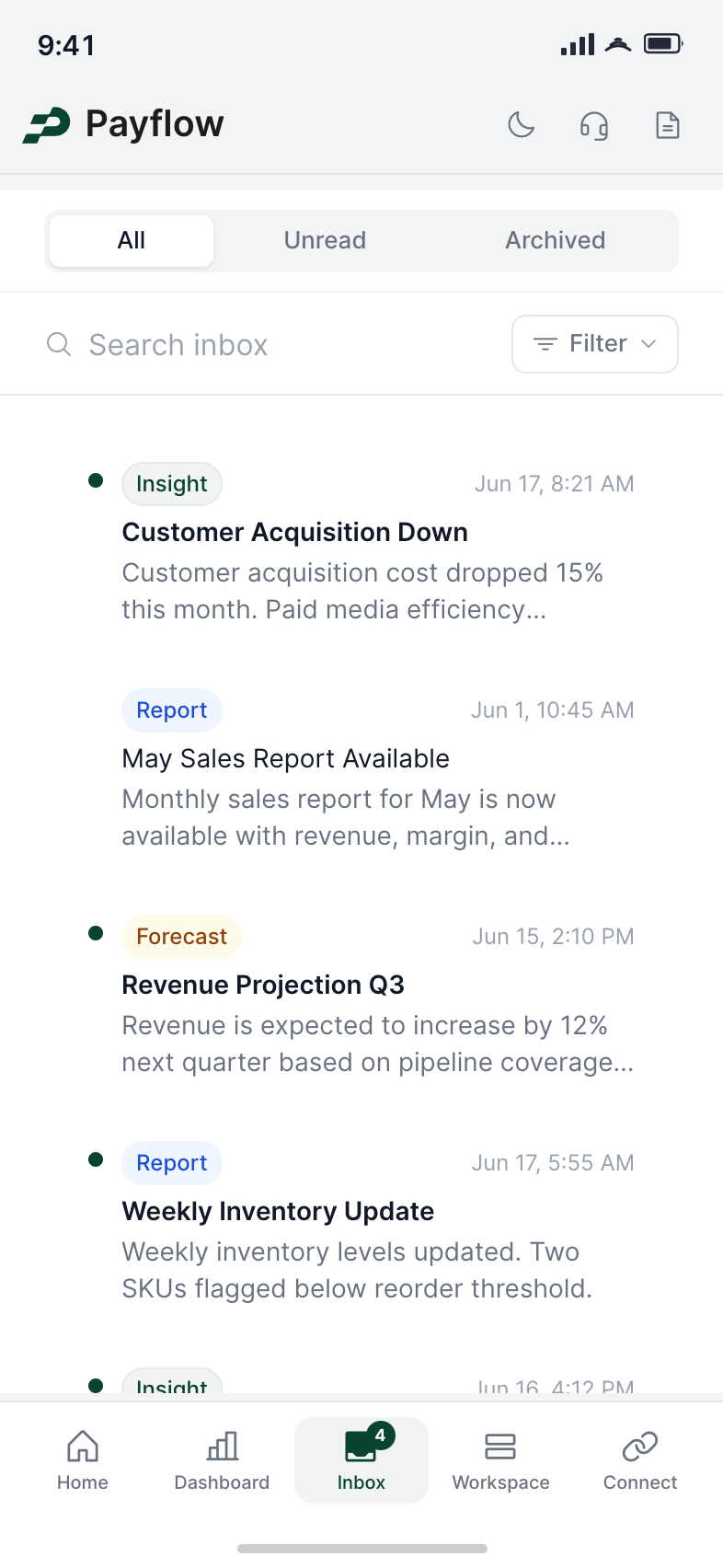
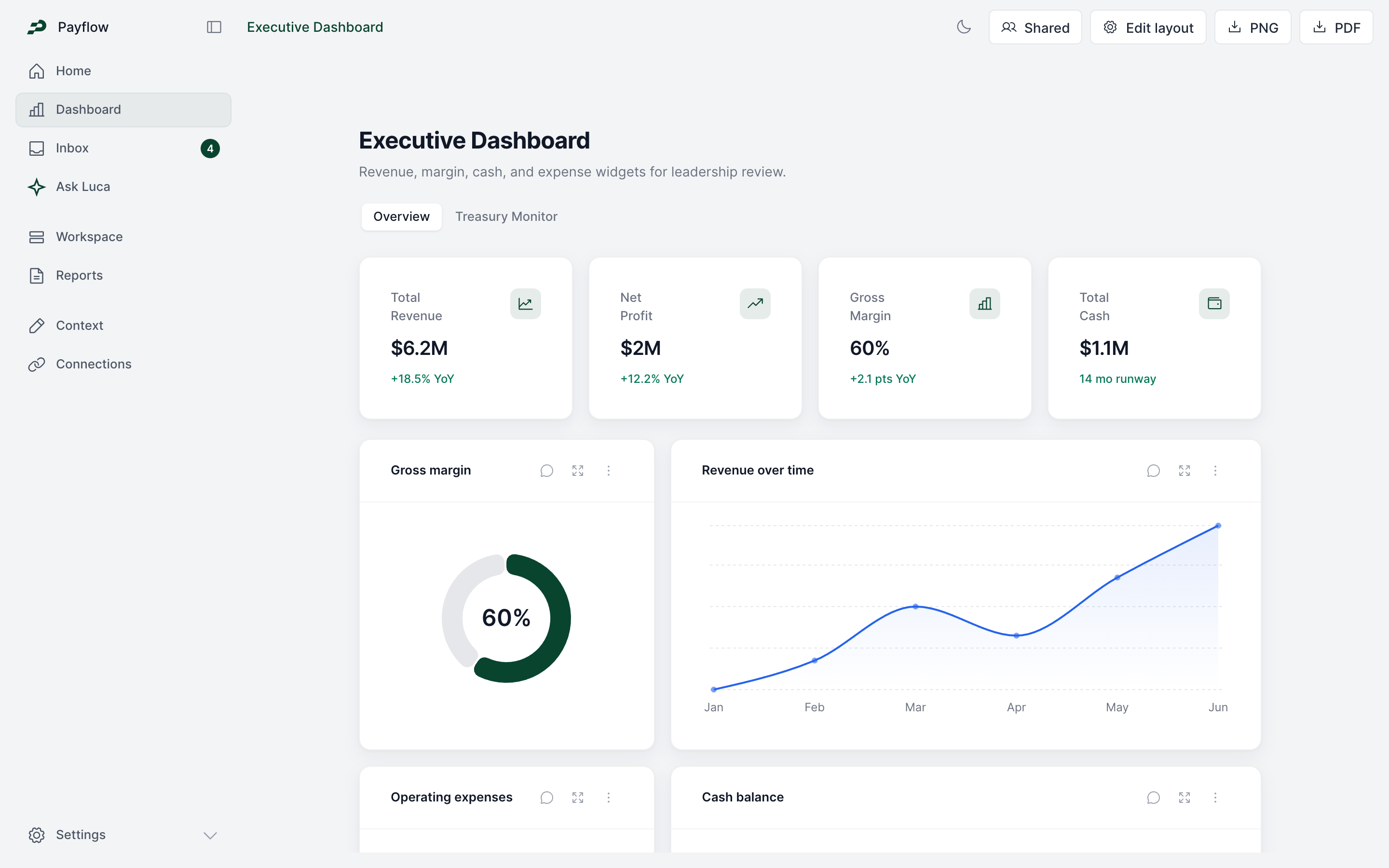
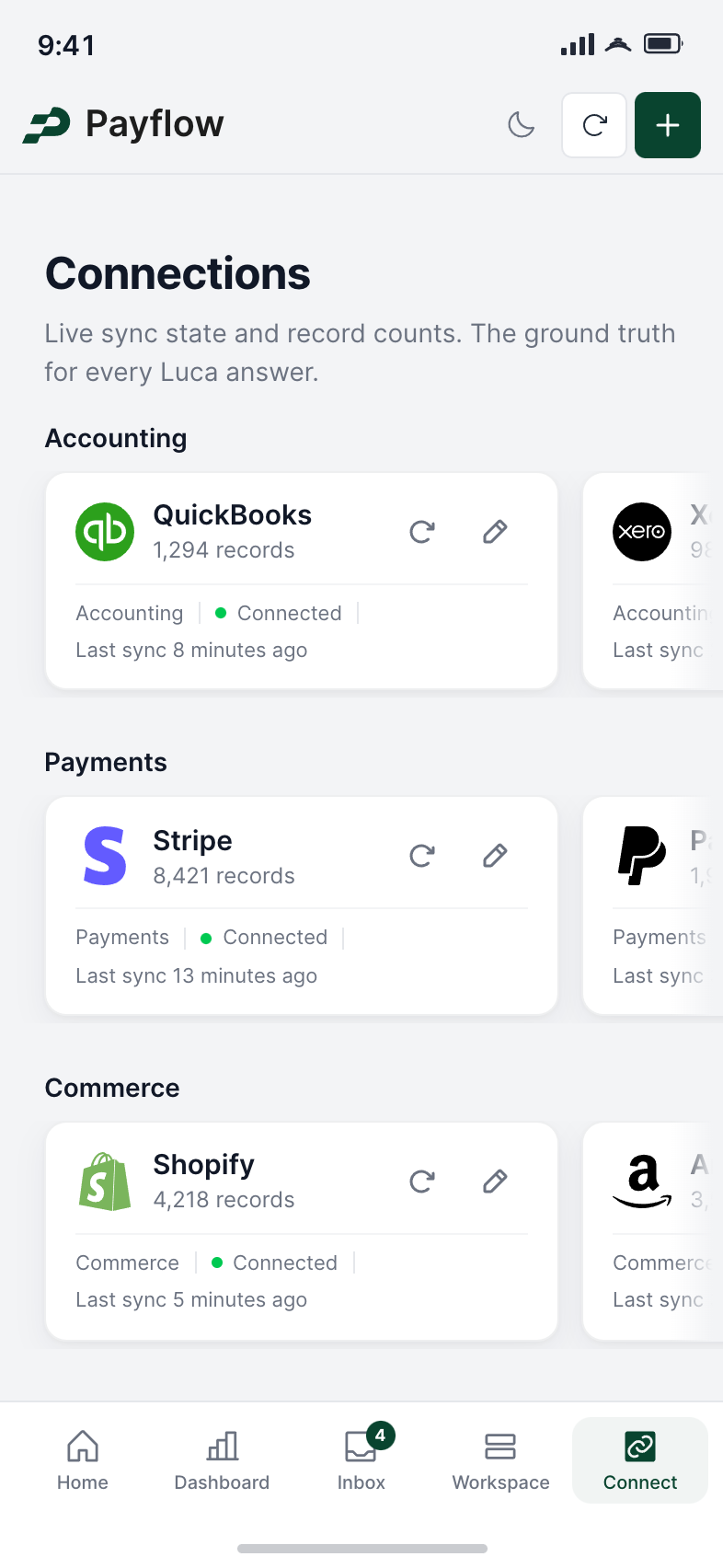
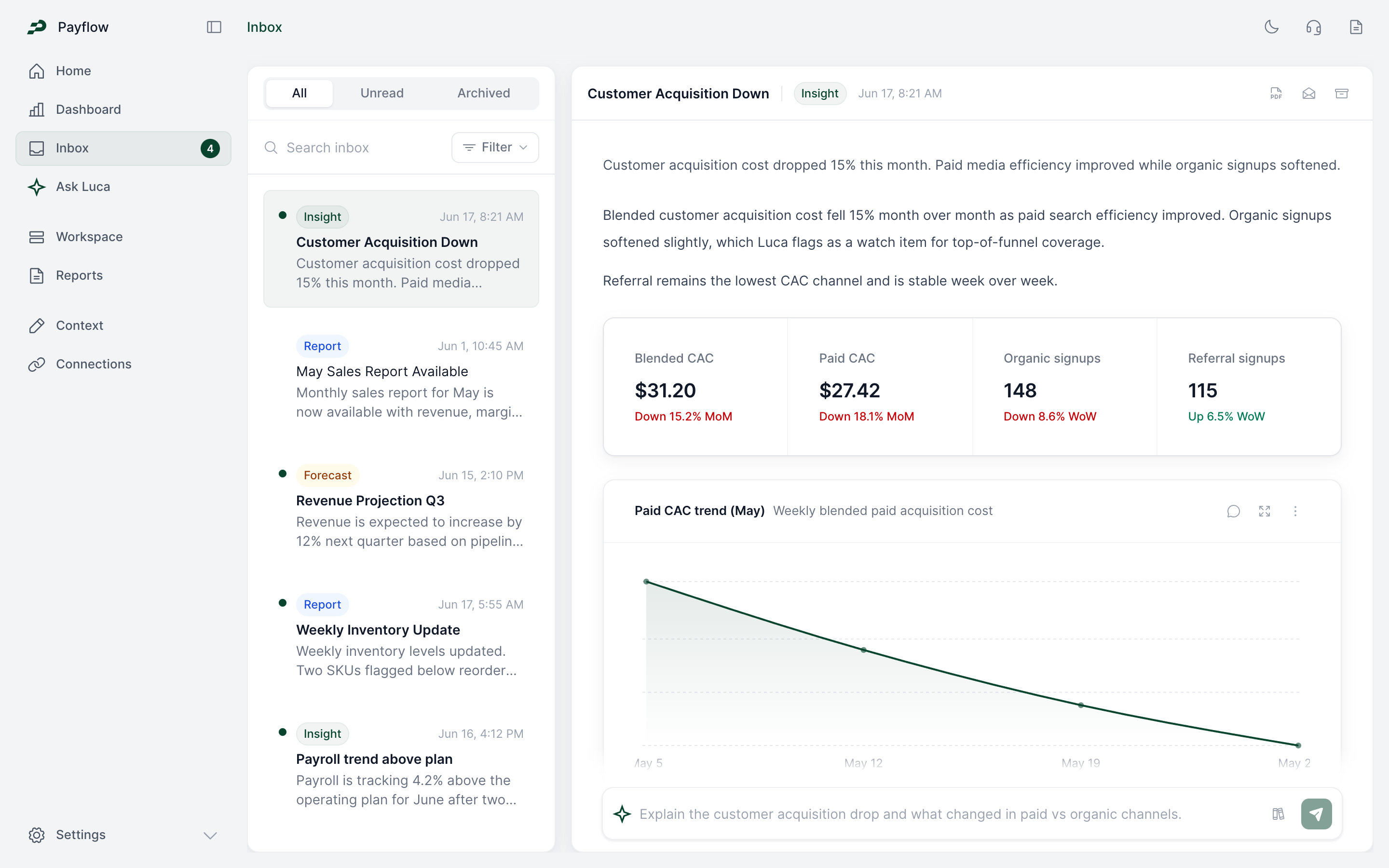
A finance and accounting AI workspace where every answer traces back to its source file, integration, and assumption. The team credits that provenance with a 4× lift in time spent with the AI agents.
The problem
Problem
Solution
“I'll happily let software do the math. I will never let it do the math somewhere I can't see.”
Why now
Generative AI in finance is forecast to grow from about $2.9B in 2025 to roughly $26B by the early 2030s (~31% CAGR).3 97% of finance departments report some AI use, yet only ~14 to 17% have moved past pilots into core workflows.4 The blocker isn't appetite or accuracy. It's trust, auditability, and explainability. That gap is the design opportunity: the team that makes AI legible to finance operators wins the at-scale market.
Who I designed for
Maya runs finance for a Series-B company. She lives across QuickBooks, Stripe, Mercury, and Shopify, and turns six data sources into one board narrative every month. She isn't anti-AI. She's accountable. If a figure is wrong, it's her name on it.
Her jobs, in her words:
Note
Designing for Maya reframed the product: the hero feature isn't the answer. It's the trail behind the answer. Every screen had to make verification a one-tap reflex, not a research project.
Low-fidelity structure
01. Home
Ask Luca, or bring in context to ground the answer.
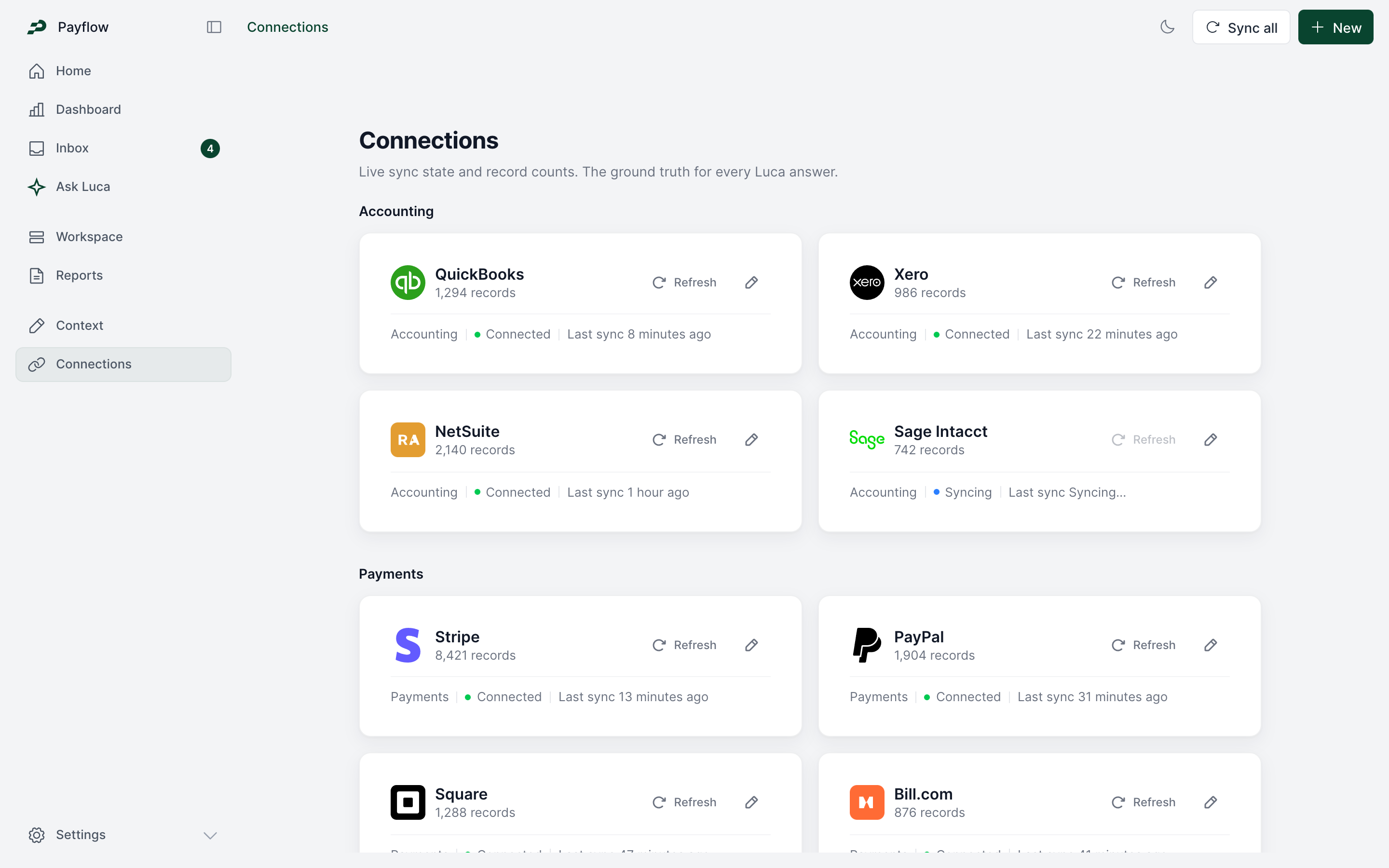
Real product surfaces, no scripted overlay
01. Ask in plain language
No query syntax. Maya types the board's question as the board asked it.
The system, in full
Dashboard: leadership KPIs, ask-this-chart on every widget.
Reports: board packets that regenerate on a cadence, pre-cited.
Context: the evidence base Luca draws on, dropped in once.
Settings: identity, team, and the accounting data Luca can reach.
Mobile-first, not mobile-after
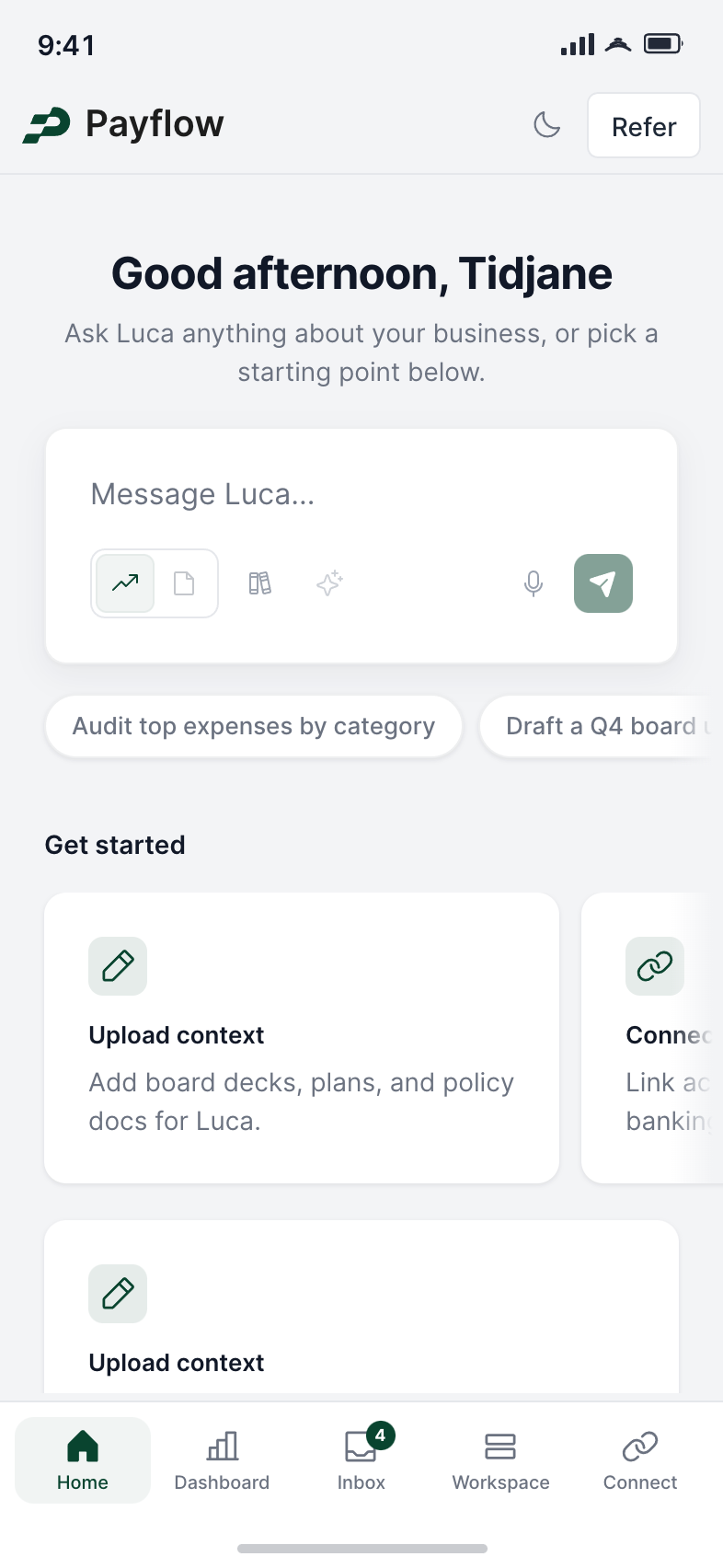
01. Ask from anywhere
Type the board's question, or tap a suggested starting point.
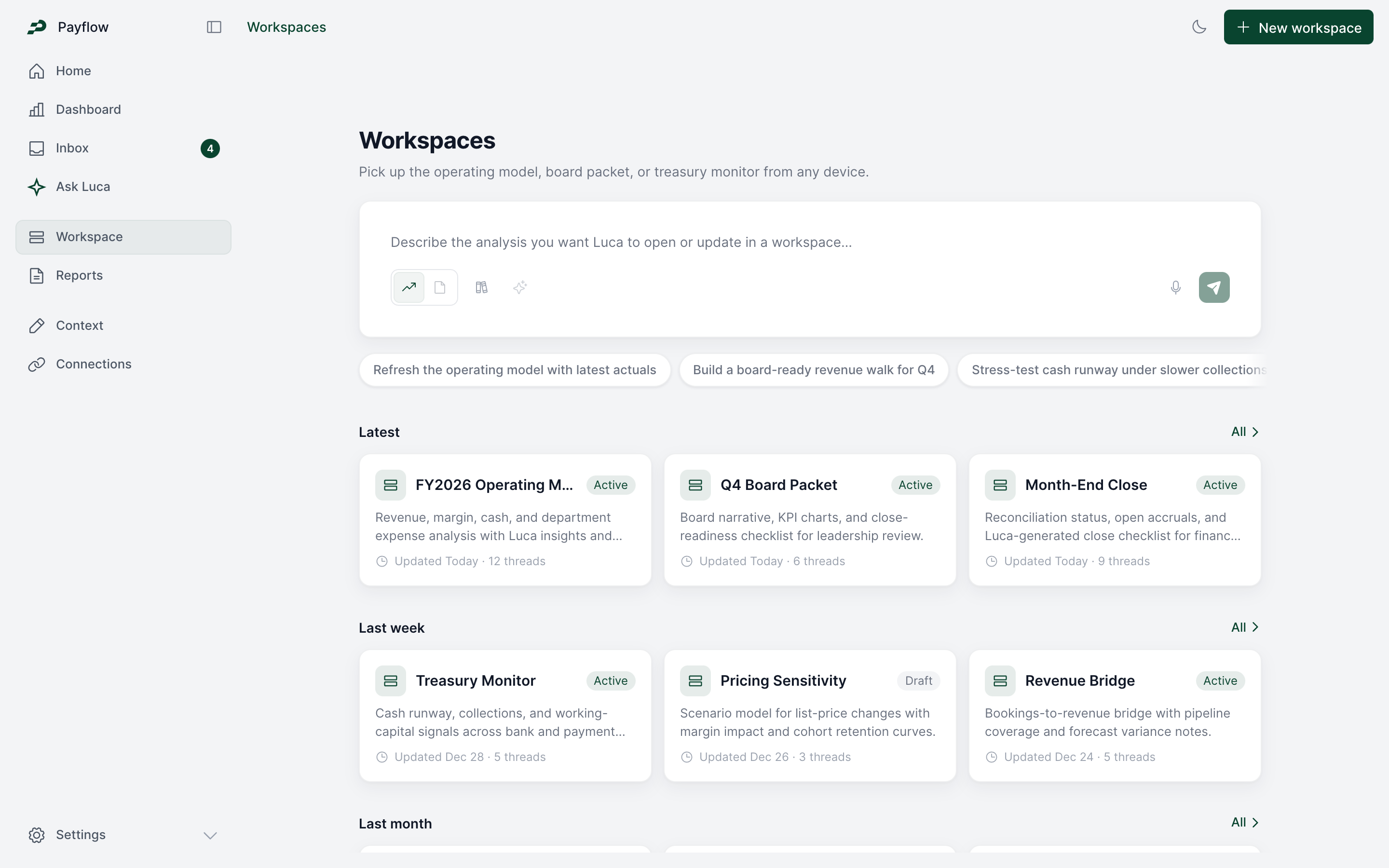
The deeper surfaces hold up too. Workspaces and the context library keep their structure on a phone, so Maya can pick up the operating model or drop a board deck between meetings, trail intact.
Workspaces: pick up the operating model or board packet anywhere.
Context: drop a board deck and it becomes part of Luca's evidence base.
What I built
One charting vocabulary. Waterfalls for revenue-to-profit walks, area for trends, donuts for composition, all on one restrained palette anchored on a single brand green. A chart never gets decoded twice.
Provenance as a persistent footer. Assumptions and Sources stay pinned to the report at the shell's header height, with an accent active state, never a hidden modal. Drilling back to a source is a reflex, not a hunt.
Ask-this-chart everywhere. Every chart and metric is a conversation starter, so verification and follow-up happen in place, not in a new thread.
Live components, recomposed
Revenue to net profit
Trailing six months
Revenue
$4.2M
+12%Expenses by department
This quarter, in $k
Cash on hand
$1.84M
Gross margin
Up 3pts on the quarter
Ask Luca
Context library
Evidence Luca can cite
Drop a board deck or export
PDF, CSV, or XLSX, up to 25MB
Revenue mix
By line of business
Net burn
$310k
Provenance footer
Pinned to every answer. One tap from a figure to its source, integration, and assumption.
Cut from the build · A standalone 'Sources' tab
What we tried. Early on, lineage lived in its own tab: clean to build, easy to scope. It demoed fine because the demoer knew to open it.
Why it lost. In testing, nobody opened it. For a busy controller, provenance one click away doesn't exist. I moved it into a footer pinned to the answer. Verification had to be ambient, not a destination.
What it moved
“Overhauled product through rapid iteration leading to 4x increase in time spent on platform with AI agents in 2H 2025.”
Note
The lift tracks the thesis: when verification is ambient, operators stop bouncing out to spreadsheets and stay in the product. The metric I'd chase next is time-to-trusted-answer: how fast Maya gets from the board's question to a number she'll stake her name on.
What I learned
Two more months
The temptation in finance AI is to make the answer prettier. The real work is making it checkable. Once I treated provenance as a structural layer instead of a feature, every other decision (the persistent footer, ask-this-chart, the shared data-viz language) followed almost automatically. People spend time inside a tool they can verify. If I restarted, I'd instrument time-to-trusted-answer from day one. The interaction model was right before I had the telemetry to prove it.
- Tidjane
Shipped with
A production React app with a Recharts data-viz language: Cursor and Claude Code in the editor, Figma for the system, GitHub for delivery.











Shipped with
Notes
PwC Finance Effectiveness Benchmarking (median across ~1,000 companies): ~39% of finance resource time spent on manual, automatable tasks. Directional industry benchmark.
Month-end close benchmarks, 2025: cash reconciliation ~20 to 50 hours/month and the #1 time sink; ~50% of teams take 6+ business days to close. Manual-entry error rates run ~1 to 4%. Aggregated industry reporting.
Generative-AI-in-finance market sizing: ~$2.2 to 2.96B (2024 to 2025) growing to ~$13.8 to 25.7B by the early 2030s at ~31 to 37% CAGR (Grand View Research; The Business Research Company). Broader "AI in finance" estimates run higher ($38B to $190B by 2030, MarketsandMarkets). Third-party forecasts; figures vary by scope.
~97% of finance departments report some AI use, but only ~14 to 17% have reached at-scale deployment in core workflows; trust, auditability, and explainability are the cited blockers. Aggregated CFO/industry surveys.
"4× increase in time spent on platform with AI agents in 2H 2025" is a company-reported outcome, attributed to Payflow's Co-Founder & CEO. The supporting figures (one-click provenance, 7 surfaces, responsive to 402px) describe the design system as built and verifiable in the interactive representation at /payflow.
Lines of code and call minutes are the author's own estimates of effort as the lead Design Engineer on this work, not instrumented analytics. They reflect the production build and the research and demo cadence across 2H 2025.
Other projects worth a look.