Instacart logo
Instacart

In-Store Wayfinder

I designed an in-store wayfinder that helps shoppers find products in unfamiliar stores through aisle locations, store maps and route guidance.

  • Mobile App
  • UX Research
  • Wayfinding
  • AI

Project overview

  • Overview

    Find items in an unfamiliar store

    An in-store wayfinder connecting item locations, shopping lists and store maps.

  • Role

    Product Designer, Shopper Experience

    Research synthesis, interactive prototypes, retailer reviews and implementation specifications.

    Team: Product manager, lead developer and research partner

  • Problem

    Too much time finding items

    Unfamiliar layouts and products make it harder to locate the next item. Shoppers need guidance that fits the shopping list already in their hands.
  • Solution

    Connect the list to the store

    Put aisle information beside each item, let shoppers confirm its location, and offer a store map for planning the route.
Animated wayfinding prototype moving between an item sheet, shopping list and store map
The prototype connects item details, the shopping list and a store map.

Understand the store before drawing the route

Store visits and shopper interviews informed the brief. Conversations with store managers added the retailer perspective: maps, storage systems and aisle organization vary between stores.

The interview and survey summary identifies three obstacles: unfamiliar stores (35%), unfamiliar items (29%) and variation between stores (40%).2 The design needed to connect a product name to a useful location across different layouts.

Compare a camera overlay with a store map

The sketches explore both directions. A camera overlay would require a new tracking stack. A map-based approach can pair the shopping list with store layouts, but still depends on useful item-location data and shopper input.
Original sketches comparing an aisle camera overlay with a top-down route through a store
Early camera-overlay and store-route concepts.

Reveal the location at the level the shopper needs

Show aisle numbers beside the shopping list, locate one item on a compact map, and connect the remaining picks to a store route. Keep found and not-found actions close, with a selectable item strip on the larger map.
Shopping-list exploration with an aisle number beneath each product
Aisle information stays beside the shopping list.
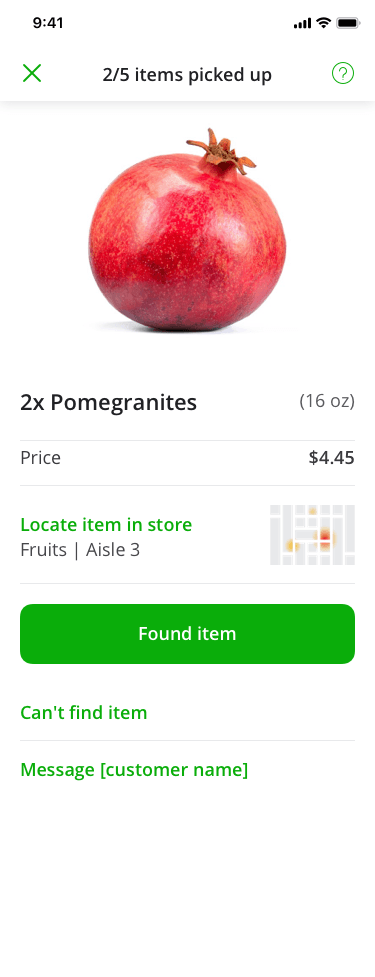
Item sheet with a highlighted aisle, product details and found or not-found actions
A compact map helps locate and confirm one item.
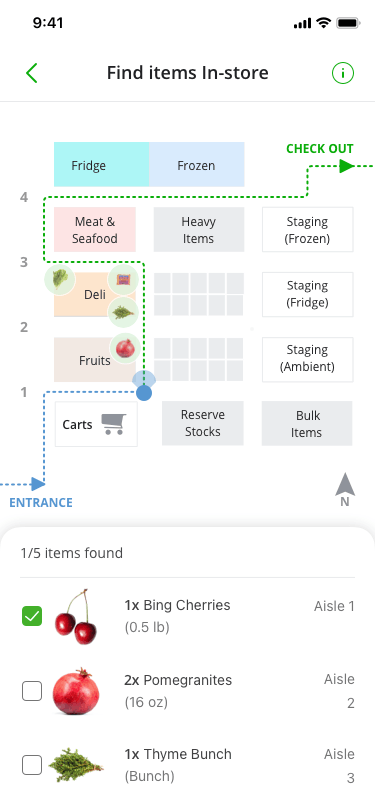
Store route with product locations and a selectable item strip
The larger map connects individual picks to the route.

Earlier item and map explorations

One concept opens an in-store location from the product detail. Another keeps the remaining shopping list beneath the map, connecting the current item to the rest of the order.
Earlier product detail with a locate-in-store action, aisle information and item confirmation
Earlier store-map variation with a route above a bottom sheet of remaining items

Connect shopper needs with retailer operations

Retailer coordination and implementation specifications connected the wayfinder with store maps and aisle organization. The stakeholder goals were stronger retailer relationships and storage integration, better shopper earnings, faster deliveries and increased Instacart revenue.

Pilot results

The original project recap reports an 80-store pilot and a 30% faster shopping experience.
Faster shopping experience reported in the pilot1
30%
Stores in the reported pilot1
80 stores

Shipped with

  • Product manager

    Product priorities and retailer coordination

  • Lead developer

    Technical feasibility and implementation

  • Research partner

    Shopper interviews and research synthesis

Notes

2 references
  1. Note
    Author-reported results from the original Instacart project presentation: 80 pilot stores and a 30% faster shopping experience. The presentation does not provide the measurement window, comparison method or separate item-search metric.
  2. Note
    The original interview and survey summary labels unfamiliar stores 35%, unfamiliar items 29% and store variability 40%. The sample size, survey denominator and method are not recorded.
More work